
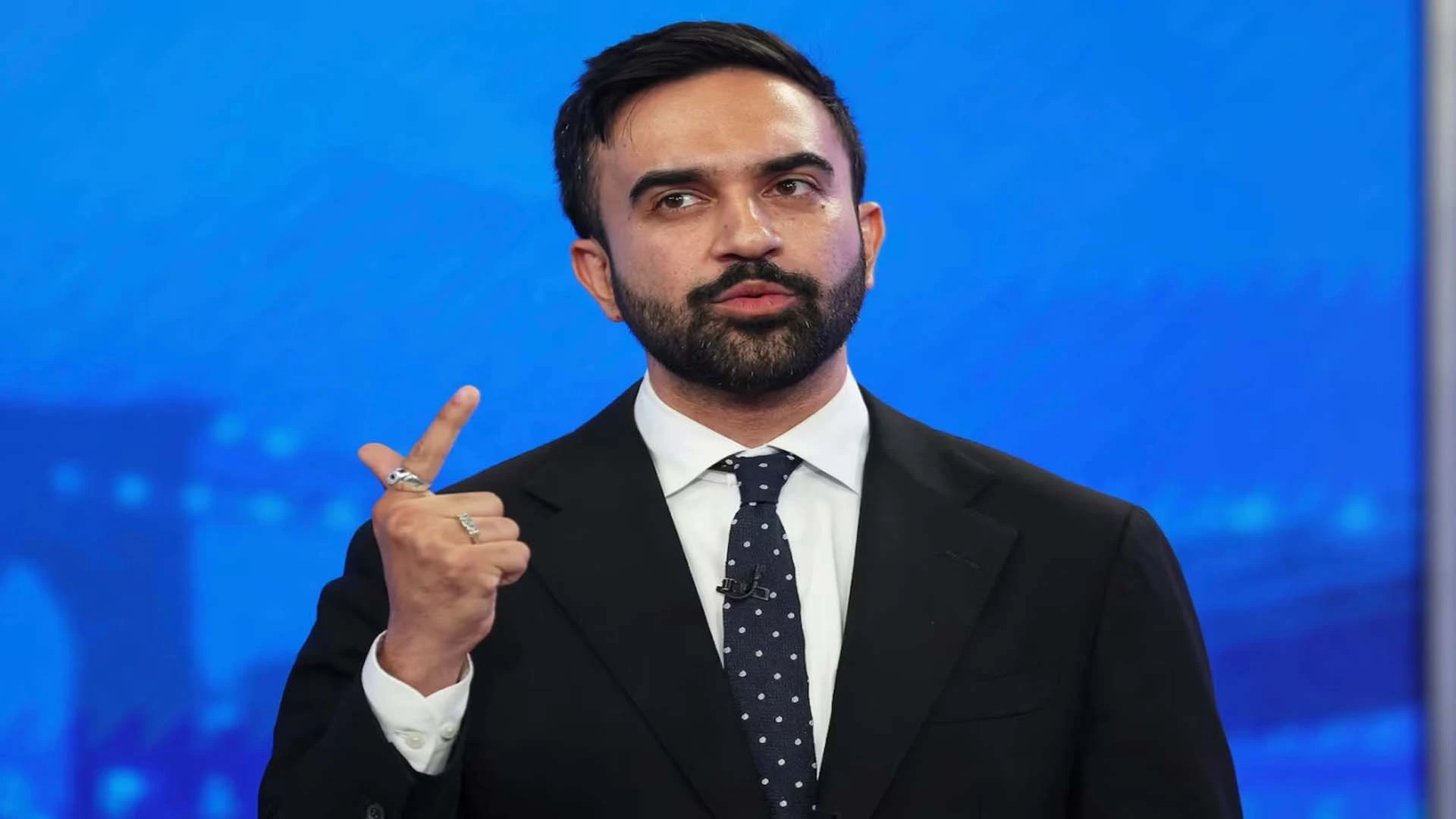
Gracie Mansion—the official residence of the Mayor of New York City—got its new occupant on 4 November 2025. The name is Zohran Mamdani, an Indian-origin Muslim, who once protested alongside some Pakistan-Occupied Kashmir (POK) supporters against the attempt to construct the Ram Mandir atop the ruins of the Babri Masjid.
This is the same masjid that was created after demolishing the Ram Temple, as noted in various Persian, Arabic and Urdu works written in the 19th century, and documented by historian Dr Meenakshi Jain in her book The Battle for Rama: Case of the Temple at Ayodhya.
The Democratic Party candidate, Mamdani, won the New York City mayoral election with 1,036,051 votes. Not a landslide victory because of the Republican candidate, Andrew M Cuomo, who got 854,995 votes, making the margin 9.6%. Landslide is considered when the margin is 15%.
Looking at the promises made by Mamdani, parallels can be drawn with Arvind Kejriwal, former chief minister of Delhi, who is also called the ‘father of freebie culture.’
Mamdani has promised the New Yorkers a free public bus system, free childcare, government-run grocery stores, a freeze on rent increases, improving infrastructure, etc.
Kejriwal, too, in the run-up to the 2013 Delhi election, made some state-funded heavy promises. These included free water, free electricity, and healthcare at reduced prices, among others—promises he went on to implement when he first came to power in 2015.
In 2019, when his government came into power for the second time in the capital after 2015, Kejriwal extended these freebies to include free pilgrimage to the elderly, free bus rides to women, and so on.
The result of all these socialist offerings? Fiscal burden and prioritisation of recurring expenditure (subsidies, salaries) over capital expenditure (buses, roads etc).
In 2024, just a few months before the 2025 Delhi election, the Aam Aadmi Party (AAP) government approached the National Small Savings Fund (NSSF) to borrow Rs 10,000 crore. In addition, Delhi Jal Board (DJB) stood at a debt of over Rs 70,000 crore.
Taken together, this shows the level to which Kejriwal’s so-called socialist policies had brought Delhi. The city’s financial capacity was severely strained and pollution continued to choke the capital.
Kejriwal came in the guise of a common man riding on the wave for change in Delhi, with the attitude of ending corruption, making the system accountable, calling out the rich, and acting as the most ideal person in politics. However, he ended up in jail under corruption charges.
Kejriwal had heavy subsidy-driven policies, but not a plan for recovering the losses incurred for those policies, except for requesting the common citizens for donations. The same goes with Mamdani, a former hip-hop artist, who knows what he will offer to the New Yorkers, but doesn’t seem to have a plan for their recovery, except asking the residents to donate.
The pattern is the same; only the locations are different!
The media have been very kind to both. The media portrayed the denier of truth, sympathetic of globalising the intifada, anti-semitic and Hinduphobic Mamdani as charismatic, relatable, the favourite, improbable, audacious and someone who is rewriting the rules of New York politics.
Kejriwal was also portrayed the same way. Someone who is an anti-corruption crusader, aam aadmi’s (common man’s) leader, reformer, honest, idealistic and confrontational.
It only showed the positive side of their ideas, ideology and vision, and did not question the practicality of any. This is why, when Kejriwal’s ideology failed, many of the Delhi people were confused, even when he was arrested: if Kejriwal is honest or the central government is going after him because of a certain agenda?
The failure is likely to be caused in the case of Mamdani as well. The reason for it is that the mediocre socialist ideology keeps the poor at the bottom, making those pretending to be their leaders very rich.
Sheesh Mahal and Kejriwal’s daughter’s lavish wedding should act as clear examples of this.
Mamdani called himself a ‘democratic socialist,’ an ideology that promises democracy but typically expands government control over major sectors of society. Critics argue the combination sounds appealing but often masks a heavily interventionist agenda.
On the other hand, Kejriwal called himself a ‘common man,’ and that portrayal made him win against Sheila Dikshit, the longest-serving Chief Minister of Delhi, who is also called the maker of modern Delhi. Kejriwal’s win showed what matters in politics: its perception, not work!
Looks like Mamdani followed Kejriwal’s playbook closely.
The 2013 Delhi election, as per Kejriwal, was an election of common citizens vs corrupt politicians and powerful corporate interests. Mamdani portrayed himself as the saviour of New York, who is for the working class and won’t spare the rich and tax them excessively. He even argued that ‘billionaires shouldn’t exist.’
Yet, interestingly, Mamdani’s election campaign was backed by 2 billionaires.
Hence, I say this is the same rudimentary, inefficient, incompetent, anti-market and restrictive socialist thinking that kept India behind China. Even though China became independent after us, our failure to adopt capitalism—and Congress’s continued infatuation with socialist ideals, reinforced by the so-called revolutionary slogans raised in universities like JNU of Mao and Lenin—kept us behind, always.
Socialism can never outplay capitalism because it destroys the very incentives that people work for. The idea was buried long ago, and every attempt to revive it only brings death to any economy.
The support from the people can be described as remarkably intense. In both cases, a win was accomplished, and people were filled with hope—in Delhi then, and now in New York.
However, Delhi eventually came to reassess Kejriwal. As a result, he lost the 2025 Delhi election. New York, too, will have to confront this reality, but how and when it chooses to do so remains the real question.
S Shiva is an independent journalist based in Delhi.