
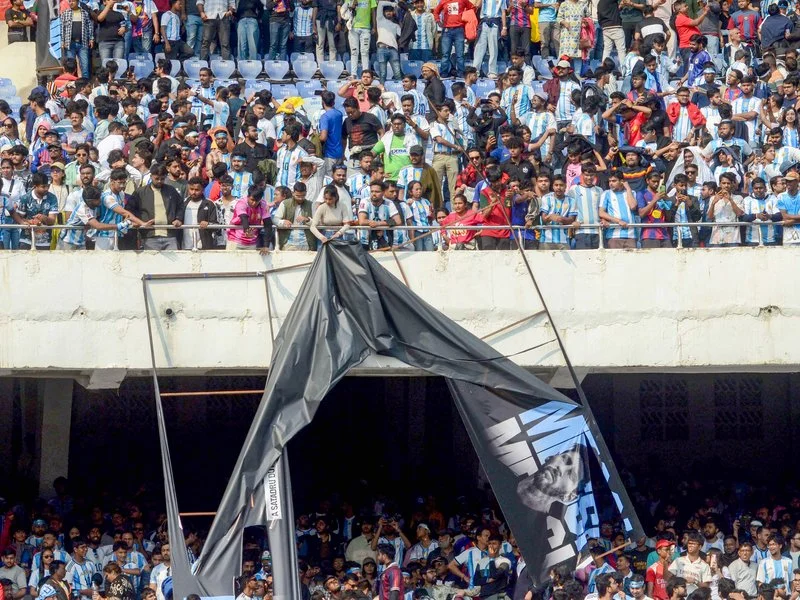
Messi’s three-day GOAT India Tour concluded on 15 December. During this, La Pulga (Spanish for The Flea) visited four cities: Kolkata, Hyderabad, Mumbai and New Delhi. While the other three cities didn’t make much news on social media. It was Kolkata that made headlines. The reason was the state government’s mismanagement and administrative immaturity in handling the event. It was an opportunity to not record anything negative. However, when it’s the Trinamool Congress (TMC) in the picture, it is hard to expect such.
Kolkata, India’s football capital, insulted the football fans. Many paid ‘hefty amounts’, yet weren’t able to even have a glimpse of Messi. But TMC politicians and their family members didn’t face any trouble in interacting with Messi. For once, it appeared as if they paid to bring the world-renowned footballer to India, and not his fans. The result of all this? People turned violent and invaded the ground to go in a full-scale looting.
Clubs like Mohun Bagan and East Bengal have produced players of international calibre, not just for the country but for Asia. In a state so closely identified with the spirit of football, if reports of disorder, disrespect, and chaos make international headlines during an event with a globally renowned player, it is not merely an administrative failure—it is an affront to Bengal’s pride.
After the Salt Lake Stadium incident, West Bengal Chief Minister (CM) Mamata Banerjee made a perfunctory announcement about forming an inquiry committee, yet to this day, there is no public information regarding this committee’s progress, findings, or accountability measures. This exemplifies a longstanding malady in Bengal’s administration, where ‘announcements’ have become the substitute for governance, and ‘accountability’ appears to be a largely irrelevant concept.
Serious questions were raised about the role of the State’s Sports Minister Aroop Biswas during the event. Allegations surfaced regarding ticket scalping, disorganised entry arrangements that humiliated spectators, and a focus on VIP photo—ops and personal publicity rather than the sport itself. All this eventually led to Biswas’s resignation. In a state where unemployed youth have long awaited sports quota appointments and basic facilities, such behaviour of politicians deserves scrutiny.
Bengal has given birth to luminaries such as Bankim Chandra Chattopadhyay, Swami Vivekananda, Rabindranath Tagore, and Netaji Subhas Chandra Bose—figures who taught discipline, self-respect, and national consciousness. Today, the state repeatedly makes headlines for events that stand directly opposite to their values and highlight lapses in law and order and the insensitivity of governance.
In the Messi episode, Banerjee’s silence raises serious questions. After all, it was an event with global implications for the state’s image. When international newspapers, sports portals, and TV channels highlighted Bengal’s mismanagement, the state’s top leadership’s response was visible only through a lens. This is the same leadership that does not hesitate to appear in the media to make political accusations at the slightest provocation. This puts Banerjee in the dock.
A CM’s responsibility is not merely to retain power but to protect the state’s dignity as well. Unfortunately, Banerjee has failed miserably in this. Bengal’s identity now is defined not by intellectual depth and cultural excellence, but by irresponsible leadership.
Bengal needs leadership that advances the state through solid policies, honest administration, and the firm application of law—not emotional slogans raised in loud voices. If that responsibility is ignored, the hope of ‘nothing negative’ will remain exactly that: a hope, ignored by those entrusted to govern.
Dushyant Shukla is a political analyst and independent journalist based in Delhi.