
Purnima Rani Shil, a 12-year-old Hindu girl, was raped on 8 October 2001. Her fault? That as the polling agent of the Awami League in Sirajganj, Bangladesh, she had protested against the electoral malpractices by the workers of the Bangladesh Nationalist Party (BNP) during the 2001 general election. The result of doing right was gruesome. Shil’s home was attacked by around 30-40 Muslim men, out of whom some of the faces were known to her. Then, this rapist mob tore Shil’s clothes and tied her face with a gamcha (a thin cotton scarf). Following this, Shil was taken to a nearby field and raped one after another until she lost her consciousness. In the same inhuman attack, Shil’s sister lost her eyesight and her father’s saloon was looted as well. And eventually, like every other Hindu family, Shil’s family was forced to flee their home.
This is not just the story of one Hindu girl, Shil, but of an uncountable number of Shils who were raped between the pre-partition of Bangladesh and 2011, and the horror is still ongoing. The lives of these Hindu girls weren’t merely disturbed, but shattered. For them, survival became a torment. They counted every day in fear of not knowing whether they would be spared tomorrow by those wearing skull caps or whether their entire family would be brutally wiped out by them.
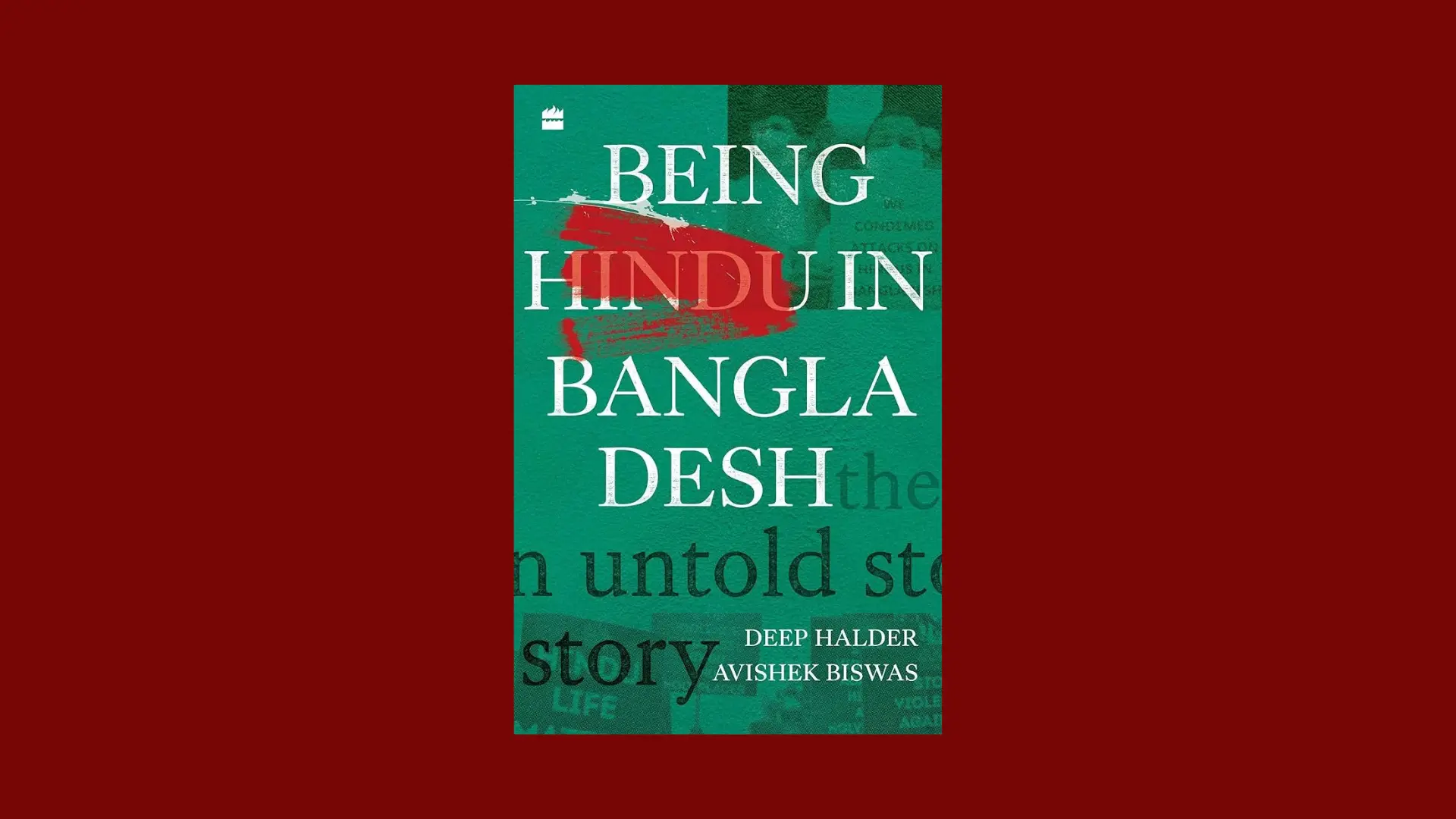
Some histories do not scream. They bleed. Bleed generation after generation quietly until silence itself becomes evidence. Senior journalist and author Deep Halder and academic Avishek Biswas’s Being Hindu in Bangladesh documents this silence with utmost sincerity. Halder and Biswas don’t merely record violence that occurred with the Hindus of Bangladesh by its Muslim majority, but also put on record to what happens when a community is neglected by its own government to be treated as its citizens.
When the neighbours of that community start practising othering with them, just because of their Hindu faith and human lives are reduced to little significance. This, too, to a level where the women of that community are freely gang-raped, members are tortured and finally killed.
The law, on the other hand, keeps sleeping.
Briefly, it tells you what happens when the majority of a nation, following a certain book, treats its Hindu minority with unbearable cruelty. Cruelty of a kind that doesn’t lie only in the brutality itself, but in its normalisation. In the way it repeats, adapts, and survives under shifting political slogans and regimes. Though, the victims remain the same — the Hindus.
In the Borguna district of Chorduari village in Bangladesh, many Hindu families endured violence so prolonged and intimate that trauma became their constant companion. The poor Hindu families faced bestial torture on their bodies. The girls of these families first lost their dignity to a psycho mob and then their mental balance.
They had no other choice, but to keep their homes open and this written on their gate: ‘Come and Do Whatever You Like’. On seeing any Muslim male entering their homes, these girls used to strip naked and stand still. Not out of consent. Not out of acceptance. But because after repeated violations, the mind learns that resistance is meaningless. Or the mind of these Hindu girls learnt that when you are a Hindu minority, you are bound to face the unthinkable, is what I understood after reading this book.
Halder and Biswas’s book is not for casual reading. It’s serious. It demands your active participation to understand what it means to be a Hindu in Bangladesh — a Muslim majority nation. It is a record of survival in a land where ‘identity’ itself has become a ‘liability’. Through meticulous documentation, survivor testimonies and historical continuity, this book exposes the Hindu minority’s lived reality. A reality in which there is a permanent state of fear that did not begin yesterday nor did it end with Bangladesh’s independence.
Halder and Biswas’s narrative mainly spans from pre-Partition Bengal to the Liberation War of 1971, a conflict often remembered as a struggle for Bengali nationalism, but for Hindus, it marked one of the most violent ruptures in history. Hindus were not collateral damage in this ‘pretended’ struggle; they were deliberate targets. They were identified, targeted, killed, converted and displaced, like always. Meaning, independence of Bangladesh from Pakistan offered very little security to the Hindus. In a nutshell, the promise of a secular Bangladesh remained largely theoretical for them.
From 1971 onward, Halder and Biswas trace recurring cycles of violence, conversions, discriminatory laws, temple demolitions and brutality on the Hindu women. These were not isolated riots; these were patterns, repeating with horrifying regularity over decades. Then, the authors chart the gradual Islamisation of Bangladesh in the 1980s and 1990s, showing how legal, political and cultural shifts systematically pushed Hindus to the margins.
By the 21st century, for them, the attacks had become almost predictable. Whether those attacks were erupting during elections, religious festivals, or on the slightest so-called provocation. On top of this, the violence of 2001, 2016 and 2021 was openly executed and largely went unpunished by the state authorities. If you want to hear the precise number of sexual violations committed. Then, a judicial commission of Bangladesh found that over 200 Hindu women were raped after the 2001 parliamentary election.
What gives this book its moral weight is not only its historical structure but its ground-level testimonies and research. Halder and Biswas have documented incidents across different districts of Bangladesh and talked directly to survivors. Priests who saw temples reduced to rubble were heard, women who carry the lifelong trauma of rape were allowed to speak and families who witnessed neighbours hacked to death were observed.
In less than 200 pages across eight chapters, Being Hindu in Bangladesh does not overwhelm with statistics. Instead, it accumulates truth slowly, relentlessly, until denial becomes impossible for one.
For Hindus in India, we are the majority here, yet our religious processions are attacked, temples are desecrated, beliefs are mocked, saints are demeaned, attacked and whatnot. Now, I would request you to think about the condition of our Hindu brothers and sisters in Bangladesh. What all do they have to go through on a daily basis?
This book is a necessary read, especially for those who aren’t aware of the atrocities on us, the Hindus. It will take you to an uncomfortable, but essential question: How is the Hindu minority treated in a Muslim majority nation, and how quickly does dignity vanish when the state withdraws protection from this community?
Being Hindu in Bangladesh is not written to provoke momentary outrage. It is written to document unheard truths. Truths, that history has repeatedly tried to bury. It does not ask readers to pity Bangladeshi Hindus. It asks them to acknowledge that their suffering is real, continuous and ongoing.
Akanksha Singh Raghuvanshi is a physics postgraduate student who is engaged in reviewing books and writing on Indic studies.