
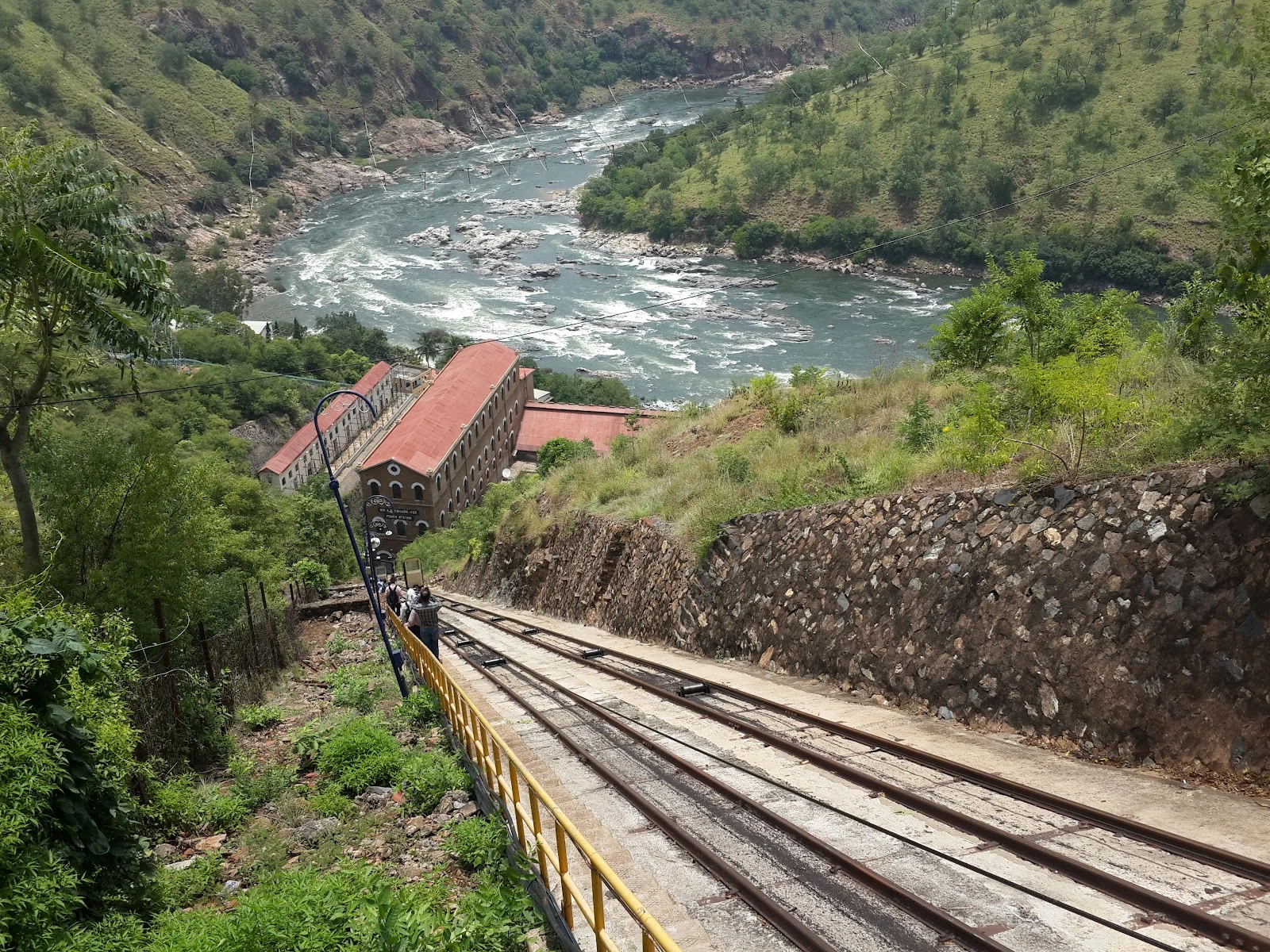
Most engineering students who visit Shivanasamudra Hydroelectric Station are never told its significance and how India taught the world the long-distance transmission of electricity. It is this plant that made steam power obsolete.
This is to fix that gap in the knowledge. I wish I had been made aware of this in 1991 when I visited the site as an Engineering student.
In June 1902, something occurred at a remote Indian waterfall that should have shocked the Western world. A transmission line, 92 miles long, carried 30,000 volts of electrical current through the jungle from Shivanasamudra Falls to the Kolar Gold Fields. It was the longest commercial high-voltage power line on Earth.
Nothing comparable existed in America or Europe.
The achievement emerged from the vision of K Seshadri Iyer, Dewan of Mysore, and Major Alain Chartier Joly de Lotbiniere, a Canadian engineer in the Hindu kingdom’s service. Lotbiniere saw something others had missed: the Cauvery River’s 400-foot drop could turn turbines and generate power sufficient to replace steam engines at Kolar’s deep mines, where fuel costs had become prohibitive.
Iyer understood that a kingdom’s survival depended on economic capacity, not military might alone. In 1898, he commissioned engineers to travel to Niagara Falls to study George Westinghouse’s alternating current transmission system. When they returned, the plan crystallized. Mysore would not simply purchase foreign solutions. It would understand every component and build the system itself.
The venture carried substantial risk. The capital was considerable for the 1890s. The technology was unproven. The line would stretch across malaria-infested terrain, requiring 5,000 laborers. The court skeptics outnumbered believers. Yet Iyer proceeded with methodical confidence.
Construction began in 1899. Generators came from General Electric in America. Turbines came from Escher Wyss in Switzerland. But the transmission system design and execution remained under Indian leadership. Civil engineers designed channels to divert the Cauvery’s flow through penstocks. Electrical engineers stepped voltage upward to 30,000-35,000 volts using transformers, transmitted it across 92 miles of copper line, then stepped it downward at Kolar for mining machinery.
The frequency selected was 25 cycles per second, not arbitrary but deliberate. Heavy rotary converters used in mining operated efficiently at lower frequencies than the 50 or 60 hertz that would eventually become standard globally. This reflected sophisticated understanding of end-user requirements.
As a result, high-voltage power generated at Shivanasamudra flowed across 147 kilometers to the gold fields. For the first time, machines in one location could be powered by water falling in a completely separate location, separated by jungles and hills. The mining operations transformed. Deep extraction became economically viable. Steam dependence was broken.
This distinction matters. The Shivanasamudra project was not Western technology imposed on an Indian kingdom. It was an Indian administration studying Niagara Falls, acquiring knowledge, and implementing a solution that exceeded what any Western nation had accomplished in this specific domain. Technologies were sourced globally. Vision and execution were profoundly local.
The surplus power enabled Bengaluru to become Asia’s first city with meaningful electric street lighting in 1905. Nearly 100 streetlights appeared suddenly, not from gradual urban accumulation of infrastructure, but from a distant river harnessed with precision. Within a year, Bengaluru had 861 streetlights and 1,639 domestic connections.
The Shivanasamudra project reveals patterns that extend beyond technical accomplishment. It demonstrates that innovation does not flow exclusively from wealthy Western nations. A kingdom positioned as subordinate within the British Indian Empire could perceive a technological opportunity, acquire knowledge globally, and implement a solution exceeding established industrial powers. It shows that engineering excellence is not the monopoly of any nation or culture. And it illustrates what becomes possible when vision, resources, and technical competence align in a common purpose.
The subsequent obscuring of credit should not overshadow the original achievement. The Hindu kingdom of Mysore, through Iyer’s leadership and Lotbiniere’s engineering, seized a technological frontier and transformed the region’s future. That accomplishment deserves recognition as evidence of what is possible when aspiration meets capability.
This article has been sourced from ShreeHistory/X.
The Free Writers Collective is a banner under which we publish underrated gems of contemporary writing.